
Basslines
A room of Frank Bowling's 'painting' at Hauser & Wirth
If you’ve found yourself here and for some reason you’re not subscribed, hit the button below to get Bitter Lemon in your inbox for free. If you’d like to support Bitter Lemon, you can select a paid subscription:
Frank Bowling is a Guyana-born British painter, who has been working since 1959. He showed at Tate Britain in 2019 which introduced his work to a new generation.
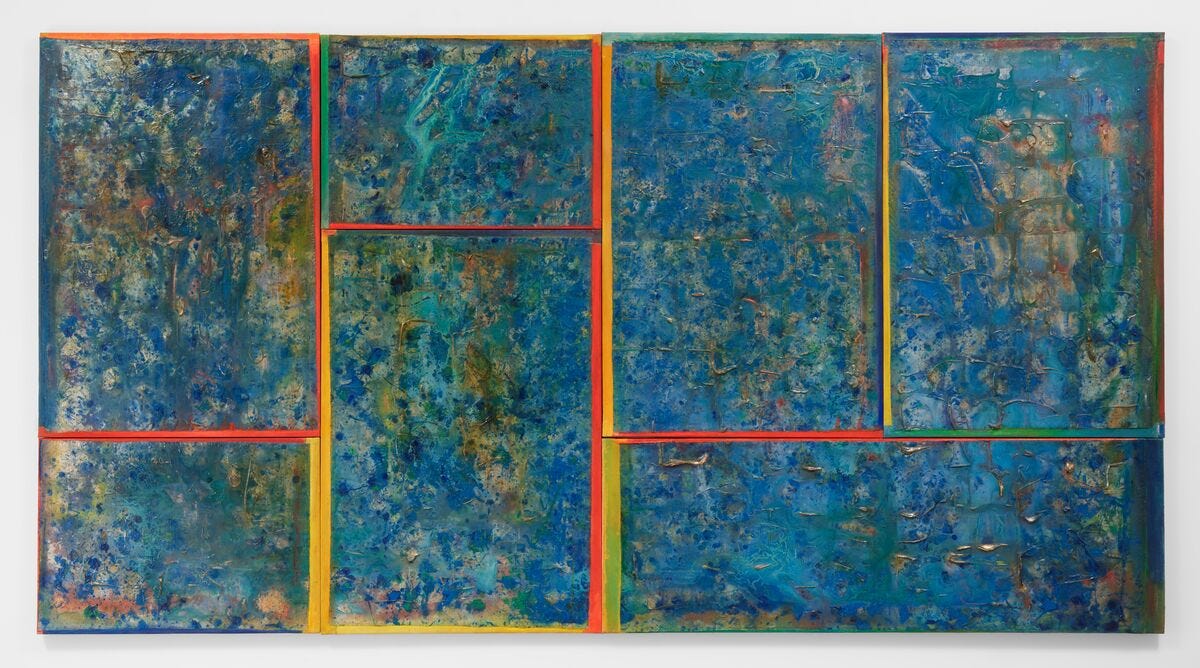
In 2020 he began to be represented by Hauser & Wirth, an international contemporary and modern art gallery. At their Mayfair showroom, I stared at his Jamsahibwall and thought about the sea. Bowling’s paintings are expansive and surreal. They shimmer with a myriad of colours all at once, and have an unsettled texture — the paint is congealed and choppy like the sea. On the other side of the room, Swimmers more directly deals with the oceanic: its vantage point seems to be the view from an incoming or outgoing fishing boat. On shore, a Cornish port caught in a fleeting moment of sunlight. The dark mass of houses is summoned with a dark splodge of paint in the centre.
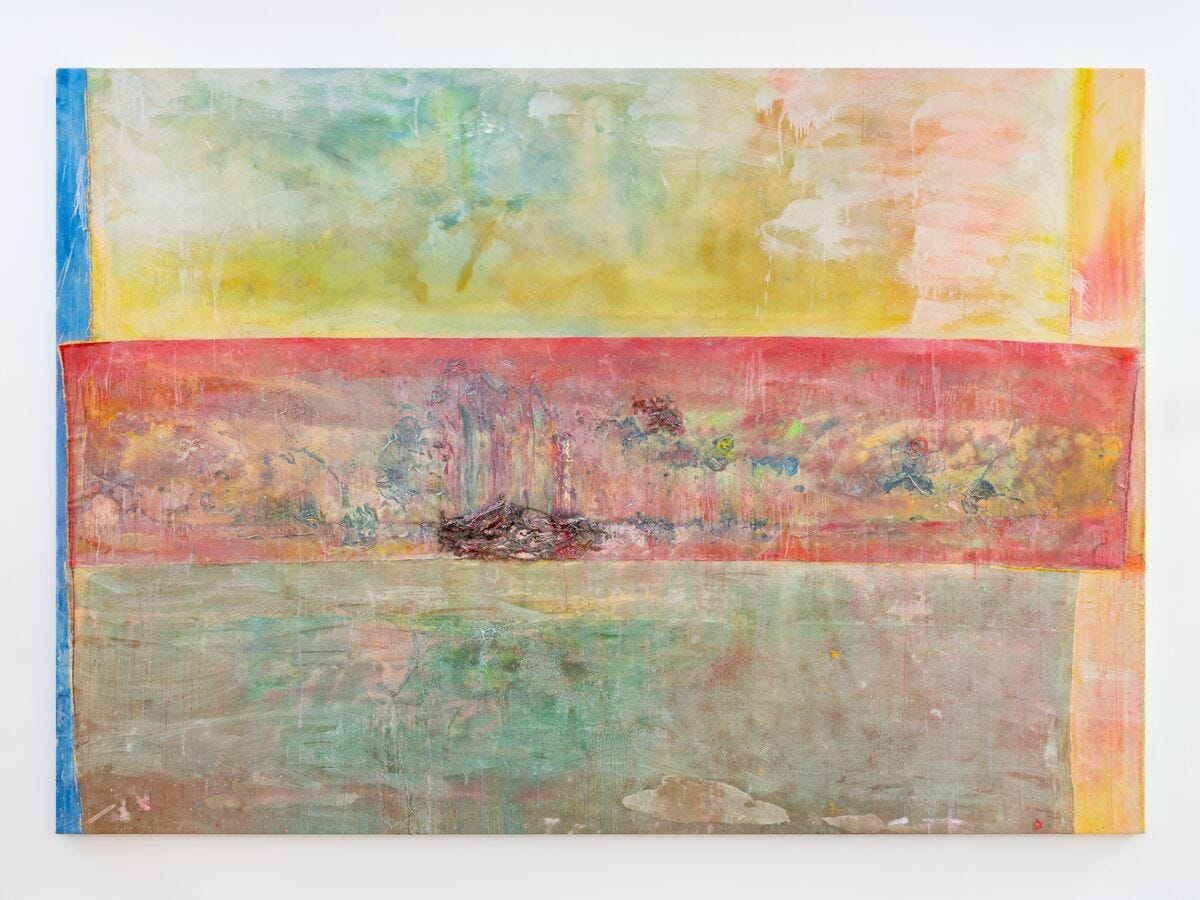
Despite dozens of colours occupying space on the canvas, Bowling is able to make all the elements hang together: the yellow sunlight melts into the blue sky which switches to a bold blue on the left-hand side. It means that his work oozes personality: it’s the kind of work that’s first-and-foremost a pleasure to look at. This doesn’t make his work unserious, and elsewhere the 87-year-old of course explores more explicitly political subjects through abstract expressionism, but from an aesthetic angle, they hum with a warm bassline.
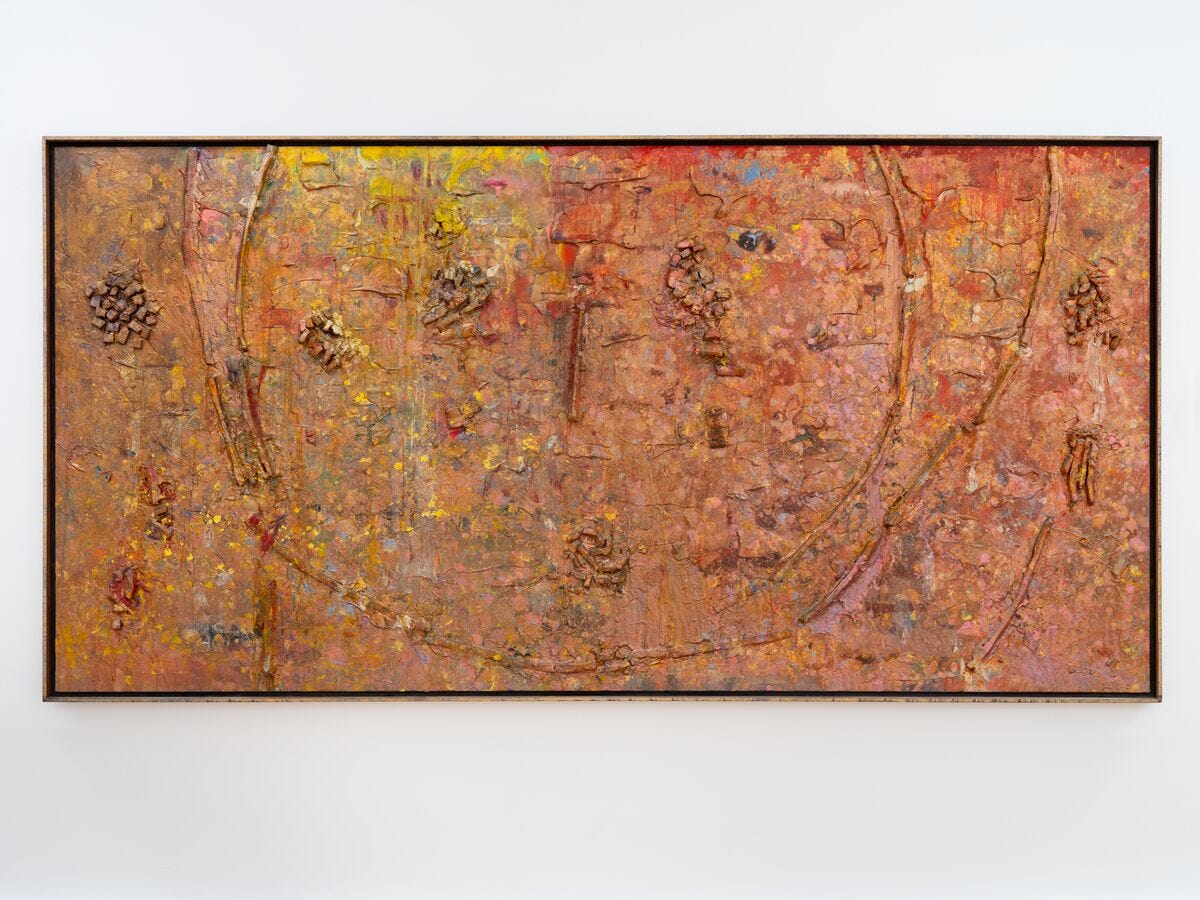
Part of that richness comes from the material Bowling uses, pushing at the edges of the form to the point where you start to question whether what you’re looking at is really a painting at all. Rockface (1985) is gaudy and brash, and part of the pleasure comes from trying to work out how Bowling has created the Martian surface. Bowling’s work here is sculptural, using found objects on a traditional canvas to bring the artwork to unexpected places. Rockface is primordial, and recalls cave art, especially the splatters of gold that look like they’ve been blown by a tube.
Bowling’s informality with paint is part of his work’s success and its coolness: Jamsahibwall and Swimmers are painted onto misshapen panels which are fixed to the canvases, laid out in collage. This works especially well for Jamsahibwall’s subject (working under the hypothesis it is about the sea): in a similar war to Monet’s panels of lilies at the Musée de l'Orangerie in Paris, the rectangles split up the water, giving some form to the subject and making room for pattern and variation between the sections. Whereas Monet is delicate, Bowling is brash, contrasting the blue with a bold orange border.
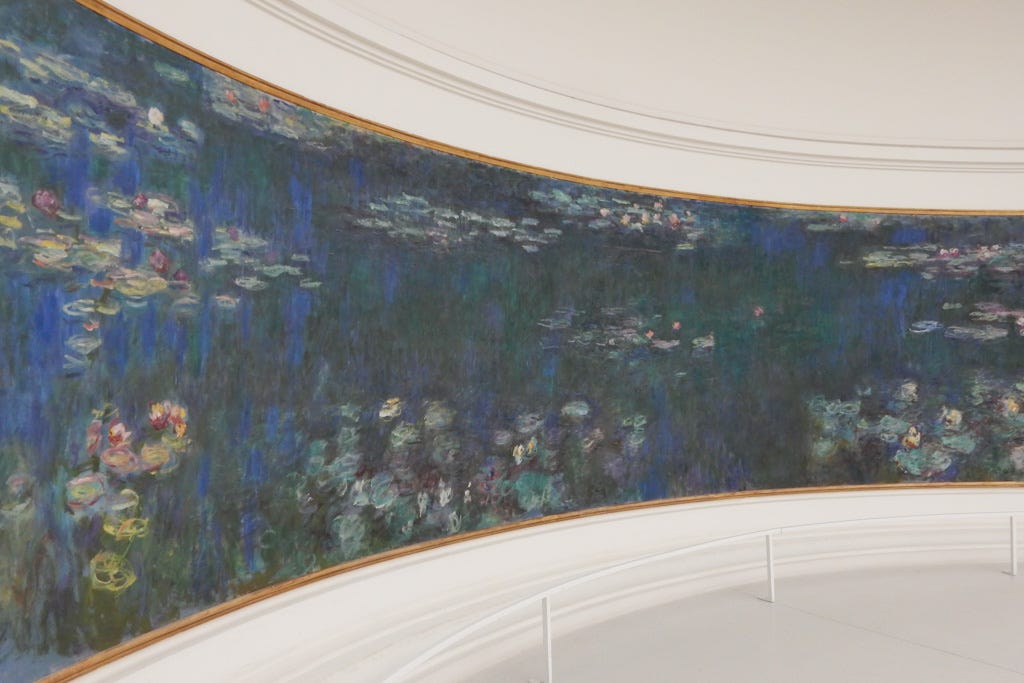
Like at the Musée de l'Orangerie, which was designed by Monet himself with just too large rooms, Hauser & Wirth presents Bowling’s work in their single room gallery space. The result: an intense and shocking burst of colour and warmth.

If you like this newsletter, please subscribe to receive it for free in your inbox! And share the URL with a friend if you think they’d enjoy it too.