
Mottled man
"Humanness", fluidity, and Burghers at the Tate Modern
If you’ve found yourself here and for some mad reason you’re not subscribed, hit the button below to get Bitter Lemon in your inbox for free. If you’d like to support this newsletter, you can select a paid subscription here:
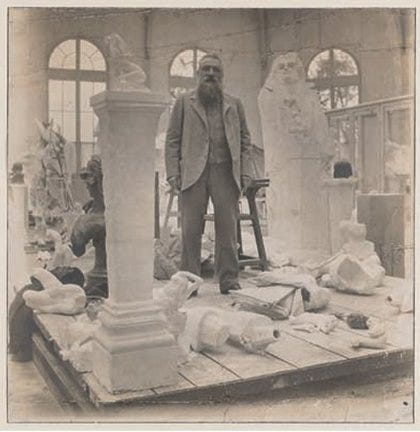
I began as an artisan to become an artist. That is the good, the only, method — Auguste Rodin (1840 - 1917)
Sculptor Auguste Rodin was born in 1840 in Mouffetard, a working-class district of Paris, the son of a police inspector. After years of rejection, he made his name in the years after 1880 with works such as The Kiss and The Thinker. He is the subject of one of the most anticipated exhibitions post-lockdown at the Tate Modern, which concentrates on his work in plaster and his “approach to making”.
When I saw the first few statues, a strange word came into my head: “humanness.” Rembrandt and Shakespeare are often praised for the “humanity” of their art — for some, they wrote and painted people “as they really were”, seeming to strip back the artifice of a stereotype, revealing the aged, wrinkle, panicked, sad, ecstatic “truth”. They resisted the categorising pressures of the society they worked within. It’s an idea to be suspicious of — can we really come to such an easy definition of “humanity”, and is this idea not too deeply rooted in Western ideas to apply everywhere — but the word came into my mind because I think it applies well to Rodin. His statues and figures aren’t straight valorisations of their subjects, they aren’t idealised forms, and therefore are more like to the humans I see every day. It takes a genius for observation, someone who can recreate the most subtle gesture or facial expression, but the work he put into achieving that is one of the important things which comes through in an exhibition that lingers long on Rodin’s process and craft.
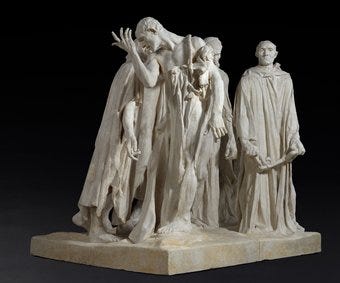
But while there is unflinching humanity in Rodin’s work, it’s achieved through manipulation and deft artistic practice. The most tragic example his sculpture, The Burghers of Paris. According to Tate, “In 1346–7, the French port of Calais was besieged by King Edward III of England. He agreed to spare the townspeople if six of their leaders surrendered to him with ropes around their necks, ready to be executed. Eustache de Saint-Pierre and five fellow citizens volunteered for the task. They were ultimately spared.” Rodin took the story as inspiration for a large-scale sculpture (a bronze version now stands beside the Houses of Parliament in Victoria Palace Gardens). How does Rodin convey the tragedy of the innocent men’s plight? Through very simple yet effective ways: enlarged hands, which show desperate gesticulation; deep-set eyes, creating darker shadows; simple tunics, which hang from their lean but strong bodies. Rodin’s choices create a sense that these men are wronged but still heroic, and showing them as a group in mid-conversation creates a truly tragic sense of commonly felt despair.
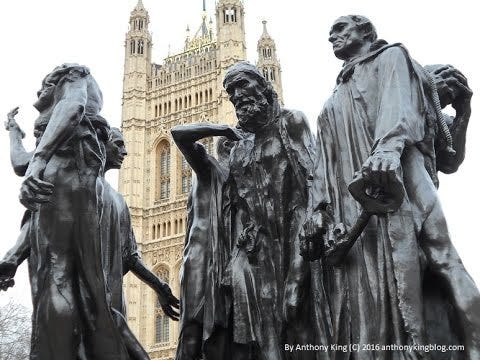
The Tate are right when they say about Burghers of Calais:
Initially Rodin planned to install the sculpture high up, to be viewed against the sky. He then changed his mind and took the burghers off their pedestal. By placing them on the same level as the viewer, showing their common humanity rather than elevating them out of reach, he revolutionised monumental sculpture.
Because of this resistance to archetype and the focus on the individual in his work, there’s an impulse to label Rodin as a “modern” artist. But that’s a cliche. We must understand Rodin on his own terms, not ours. However, his artistic method is linked to postmodern ideas, decades before they were theorised, let alone widely accepted. Rodin was a reuser, an experimenter who enlarged and switched and copied and pasted. He edited his sculptures, selecting parts and making them into wholes. The Burghers of Calais was reproduced many times, but not before Rodin selected heads and hands to use as artworks in their own right.
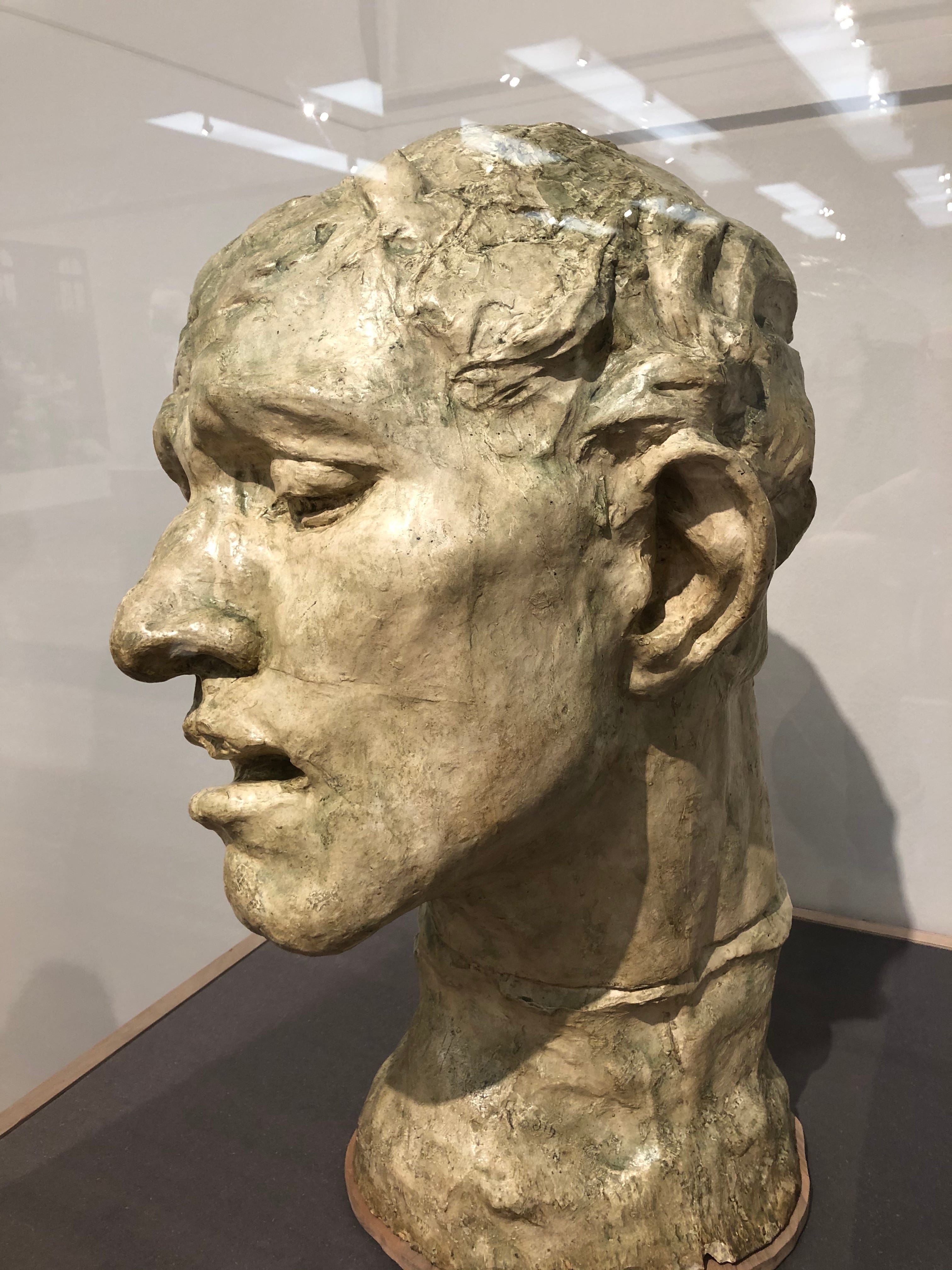
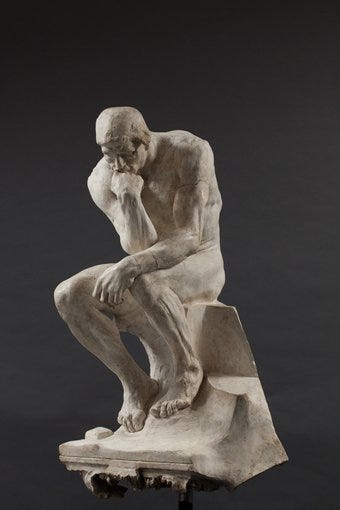
The Thinker, Rodin’s calling card, started life as a tiny ornament on a huge arch called The Gates of Hell that Rodin was commissioned to make for a museum building. He spotted the little decoration’s philosophic potential, and stripped it of its original context, enlarging it to monumental size. Rodin enlarged The Thinker’s hands beyond a natural size, dramatising the tension between the physical and mental — this huge man, this brute, is lost in contemplation, a philosopher. It’s the figuring of this tension that gives the work its dynamism: the crucial detail is that limp wrist. It’s folded hyperbolically under the chin, giving the impression the man has been sat thinking like that for a very, very long time.
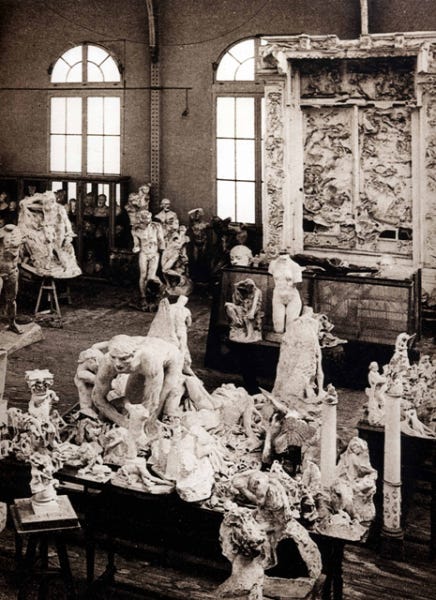
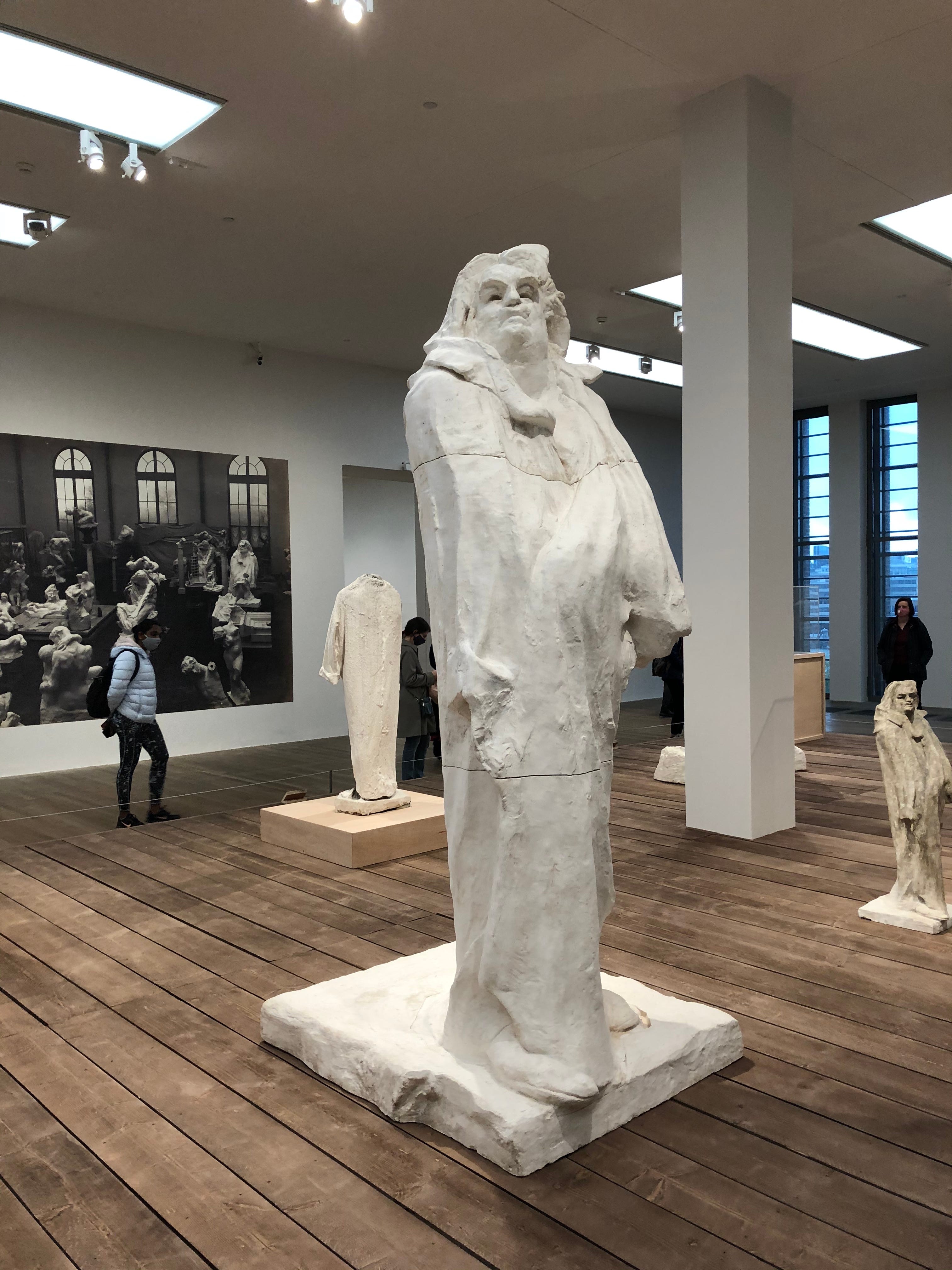
The Thinker is placed in the centre of the largest exhibition space, on a raised platform along with the other plaster works. The arrangement chimes with the look of Rodin’s own studio, captured in a couple of photographs printed on the exhibition’s walls. The show starts with a bronze, ‘finished’ work, and then deconstructs to show how it was all done, and that rhythm works; you do get a feel for Rodin’s chaotic and productive mind. The large reimagined “studio” space in the Tate is interesting: it both places you into his world and dramatises the differences between our world and Rodin’s. The Tate’s aesthetic is smooth and modern, curved and pared-back, white walls… minimal. Roden is the opposite: he neglected smooth marble (mostly) for messy plaster, his studio was really a workshop, full of mess, dust and off-cuts. It’s impossible to recreate that at a high-profile exhibition, but I still felt something like nostalgia for Rodin’s slightly unhinged impulse to make everything wild and fluid and mottled. He wasn’t cut off from other movements in 19th century France: maybe some of the decorative nature of Art Nouveau seeped its way into his constantly varying genius. We get a flavour for the chaos, but never the full thing. His work now lives in an institution where artworks are ossified, dying quietly in unseen storage areas.
Let me know in the comments what you make of Rodin, and if you end up going to show… what did you think? If you enjoyed this newsletter, forward or share it with someone who’d like it too.
Brilliant. Really enjoying these. Love those Rodins. Thank you, Peter